
This week’s dry bulk market insights offer a snapshot of the latest developments, covering key trends, market sentiment, fundamentals, rate movements and demand – supply dynamics shaping the sector.
Inflation: Bad News for Consumers, Good News for Shipowners

Recent comments celebrating inflation may have raised eyebrows among consumers, but shipowners could be forgiven for seeing things differently.
Over the past 18 months, dry bulk vessel values have increased by 20%, reflecting persistent supply chain pressures and sustained demand for essential commodities including fertiliser, grain and energy resources such as coal.
At Posidonia in Greece, confidence across the shipping sector was unmistakable. With vessel earnings and asset values remaining firm, many owners continue to benefit from market conditions that have challenged other sectors.
The reality is that inflation rarely impacts everyone equally. While consumers face higher costs for everyday goods, owners of scarce and productive assets often see values appreciate. For shipping, inflation has become more than an economic indicator, it is increasingly a driver of asset appreciation.
The Baltic Dry Index is Starting to Resemble the COVID Playbook

Chart courtesy of Signal Ocean
Recent market commentary has largely framed the current geopolitical crisis as a “black swan” event. Yet when we look beyond the daily volatility driven by headlines and policy announcements, the underlying freight market appears to be telling a different story.
By smoothing short-term fluctuations, in the Baltic Dry Index (BDI), a clearer trend emerges. Following a similar trajectory of the COVID-era shipping disruption, freight markets are showing signs of a sustained tightening rather than a temporary shock.
Today, many of those same pressures are reappearing, with critical maritime chokepoints such as the Strait of Hormuz and the Panama Canal facing operational constraints and elevated risk. The macro picture suggests that freight markets are set for a longer-term squeeze and continued upward pressure in freight rates.
The macro picture suggests that freight markets are set for a longer-term squeeze and continued upward pressure in freight rates.
When Higher Freight Rates No Longer Bring More Capacity
The Middle East crisis enters its third month, the cumulative impact on global supply chains is becoming increasingly evident, with disruptions intensifying and inflationary pressures continuing to build.

The chart above shows that the average speed of the dry bulk fleet is typically positively correlated with vessel charter rates. As daily freight rates rise, vessel operators are encouraged to increase sailing speeds, effectively bringing additional capacity into the market and helping to ease supply chain pressures. This relationship has long acted as a natural brake on freight inflation.
The Middle East crisis has fundamentally altered this dynamic. Rising fuel prices are incentivising owners to reduce speeds in order to manage operating costs, even as charter rates continue to climb. The result is a reduction in effective vessel supply at precisely the time when the market requires greater efficiency.
This breakdown is creating a double inflationary effect: higher fuel costs combined with rising charter rates. Together, they are pushing freight costs higher and adding further pressure across global supply chains. The longer these disruptions persist, the greater the impact on commodity markets and global trade flows.
Energy Market Volatility Drives New Supply Chain Inflation Pressures
Global energy markets continue to experience significant disruption, nearly three months into ongoing supply chain instability. Despite widespread expectations of sustained price shocks, crude oil prices have remained considerably below the levels initially forecast. During the early stages of the Russia–Ukraine conflict, crude prices surged to levels nearly 40% higher than where they currently trade today. This is creating the impression that the current energy crisis may be easing However, underlying market conditions suggest the disruption is far from over.

Chart source: Arrow shipping
A sharp increase in Pacific bulk cargo loading on sub-capesize vessels highlights a major shift in global energy demand towards coal, which has reached multi-year highs. As nations and industries seek alternatives to expensive or constrained oil supplies, coal substitution is accelerating rapidly, driving increased demand across dry bulk freight markets.
At the same time, tanker activity remains elevated as countries continue to secure alternative oil suppliers. The combined pressure on tanker and dry cargo shipping is contributing to a wider inflationary cycle across global supply chains.
Whilst daily crude oil volatility has moderated, ongoing disruption continues to drive broad-based energy and supply chain inflation. Rising transportation costs, fuel substitution, and constrained freig
trait of Hormuz Closure Threatens Historic Global Oil Supply Squeeze
June is emerging as a critical deadline for global oil markets. If the Strait of Hormuz remains closed beyond this point, declining global crude inventories could trigger a severe supply squeeze with significant consequences for energy markets and the global economy.

Approximately 75 per cent of the estimated 12.3 million barrels per day disrupted by the conflict has so far been offset through rising US exports and reduced Chinese seaborne imports. American oil exports have increased by almost four million barrels per day year-on-year, while China has reduced seaborne oil imports by approximately 5.5 million barrels per day by drawing on its substantial domestic reserves.
However, the market’s ability to absorb ongoing disruption is becoming increasingly limited. Should the Strait of Hormuz remain closed into late June, both the United States and China may struggle to continue offsetting the supply imbalance. This could lead to widespread demand destruction and a sharp escalation in oil prices, with Brent crude potentially approaching US$150 per barrel.
Global crude inventories already declined by nearly 200 million barrels in April alone, equivalent to a drawdown rate of 6.6 million barrels per day. If current conditions persist, the second quarter of 2026 could record the largest quarterly crude inventory drawdown in history, averaging approximately 6.5 million barrels per day. The situation highlights the growing fragility of global energy supply chains and the increasing geopolitical risks.
The True Cost of Supply Chain Disruption is Still Working its Way Through the System
In a world increasingly accustomed to instant feedback loops and real-time data, global commodity supply chains remain structurally slow-moving and outdated relics.

For both for human consumption and animal feed processing, the time between a purchasing decision and the delivery of finished goods can exceed four months, even under efficient operating conditions.
Year on year supply chain costs for transporting commodities have risen by as much as 70%. As inflationary pressures continue to concern policymakers across major economies, the full impact of ongoing Middle East disruption has yet to reach household budgets.
With no end currently in sight, each additional day of disruption across global supply chains increases the likelihood of further inflationary impact.
The challenge for markets and central banks alike is that we just don’t exactly know how severe this will become. It is this uncertainty, more than anything else, that is driving volatility across today’s global markets and creating the greatest challenges for central banks.
From Conflict to Climate: Twin Threats to Global Trade
While geopolitical conflict in the Middle East continues to dominate headlines due to its disruption of global markets, another powerful force is quietly compounding the pressure, Mother Nature herself.


Climate experts are warning of extreme thermal anomalies that could drive one of the strongest El Niño events on record this year.
The last major El Niño, three years ago, led to historically low water levels in the lakes feeding the Panama Canal. In response, authorities were forced to reduce both the number of vessels allowed to transit each day and the maximum cargo they could carry through the canal, creating significant bottlenecks in global trade.
A similar scenario now appears increasingly likely and the timing for seaborne supply chain could not be worse.
With the Strait of Hormuz under threat from geopolitical tensions and the Panama Canal facing potential climate-driven restrictions, two of the world’s most critical maritime chokepoints are simultaneously under strain.
This will place additional pressure on global seaborne supply chains, with disruptions set to ripple across commodity flows, freight costs and delivery timelines worldwid
The 50% Crisis: From Energy Shock to food Security Risk
As the daily, even hourly, cycle of on-again, off-again peace talks continues, the immediate impact of the crisis is evident in skyrocketing petrol prices.

*charts courtesy Hartland Shipping Services Research
Yet the longer-term consequences may prove far more severe. While rising energy costs are concerning, it is food affordability that poses a critical challenge for many countries. What lies ahead could develop into a humanitarian issue on a global scale.

*charts courtesy Hartland Shipping Services Research
Our theme here is 50%.
Diesel represents roughly 20% of the cost of producing a grain crop, whereas fertiliser accounts for approximately 50% of the total cost of a harvest. At the same time, around 50% of the world’s seaborne fertiliser originates from the region currently under blockade, with shipments to farmers already declining sharply, on the chart in red.
There is, at best, a 50% likelihood that global agriculture can reproduce last year’s grain crop using existing fertiliser inventories and avoid widespread crop failure.
However, there is a 100% chance that, even if production holds, the cost of food will rise significantly, potentially by as much as 50% if fully passed on to consumers. For many countries, this presents a deeply alarming outlook as the crisis continues to unfold.
Dry bulk volatility is no longer the exception but the baseline, marking a shift from cyclical swings to a constant new reality
In a paper published in February 2026, Lam, J.S.L., Li, Q. & Pu, S. highlighted a critical reality, while many commodity markets experience sharper short-term spikes, freight markets rank among the most volatile over a 30-year period. Within freight, the dry bulk sector stands out as the clear leader in volatility.
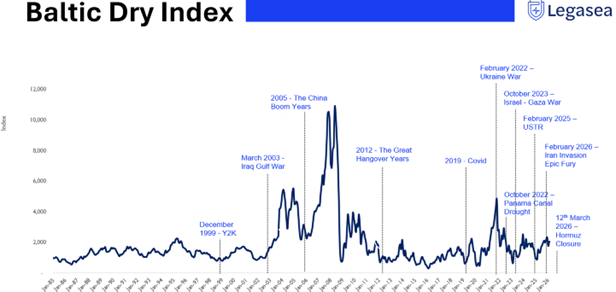
As the backbone for transporting the world’s most essential commodities, dry bulk increasingly acts as a leading indicator, a “canary in the coal mine”, for systemic disruption.
As shown in the chart, major commodity shocks historically occurred roughly once a decade. Since COVID, that pattern appears to have shifted dramatically, with disruptions emerging almost annually.
With the ongoing “open-again, closed-again” saga in the Strait of Hormuz creating significant disruption in commodity markets, it seems we are set to chart even higher levels of volatility in dry bulk freight, if that is even possible.
Freight Market Dynamics Hijacked by Brent Crude
Historically, daily movements in the Baltic Dry Index (BDI) have been a key driver of trends in commodities seaborne freight calculation. The index largely reflected seasonal and cyclical supply-demand fundamentals tied to core global commodities such as iron ore, coal, and grains, which typically followed relatively predictable patterns over monthly and annual cycles.
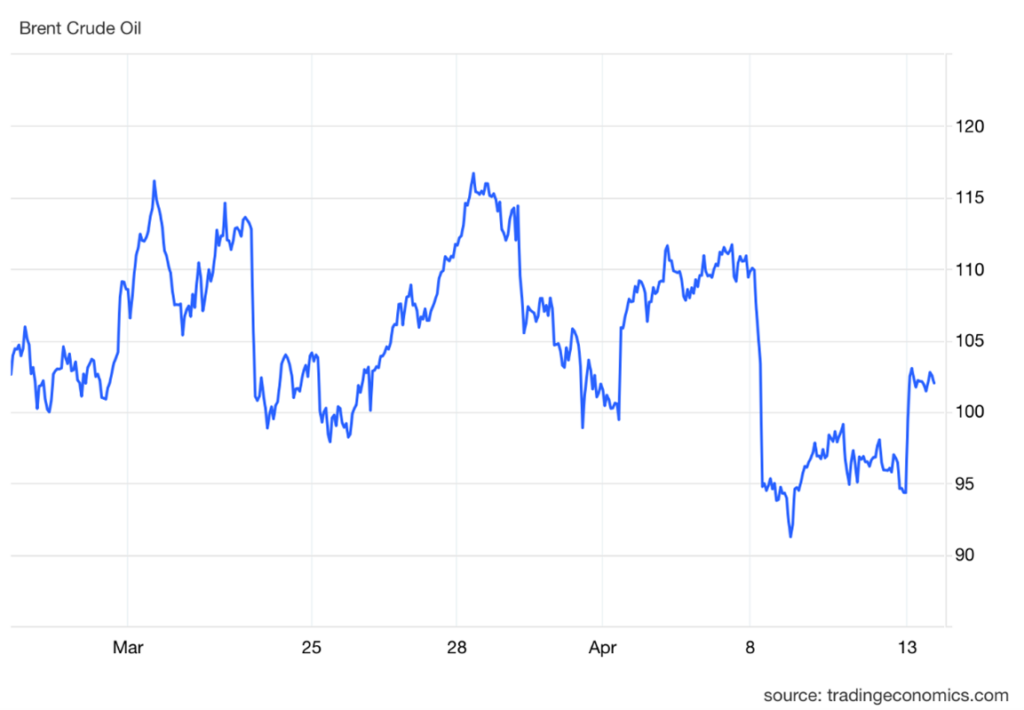
However, with vessel fuel costs now closely linked to Brent crude, the wild volatility of daily political machinations have replaced the once simpler daily calculation of seaborne freight rates.
A look at the sharp swings in oil prices since March highlights this shift clearly. Given that fuel now accounts for more than 50% of dry bulk freight cost calculations,
Oil Price Volatility Sends Shockwaves Through Commodity and Freight Markets
With fuel costs (bunker prices) representing up to 50% of the total freight cost for transporting commodities, recent fluctuations in oil prices are significantly impacting both commodity and freight markets.
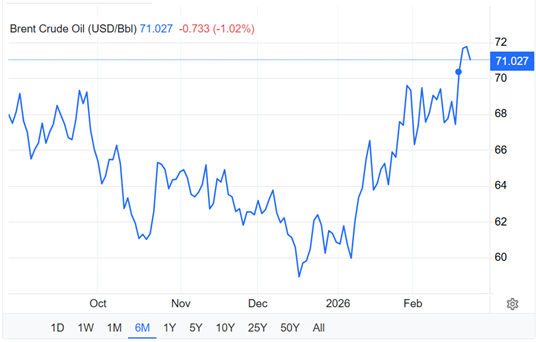
Low-value bulk commodities, such as salt priced at around USD $50 per tonne, are particularly vulnerable to these swings. Recent volatility in Brent crude, driven by escalating geopolitical tensions in the Middle East, has affected the landed export value of some commodities by as much as 10%. While consumers may grumble over rising fuel prices at the pump, it is worth remembering that those managing bulk cargo face similar or even greater pressures. If tariffs or trade disputes weren’t keeping them awake, oil price volatility certainly is.
Panamax Dry Bulk: A Decade of Underperformance Meets a Promising 2026 Shift
The Panamax asset class of dry bulk vessels have underperformed every other asset class in dollar per deadweight tonnes for a decade.
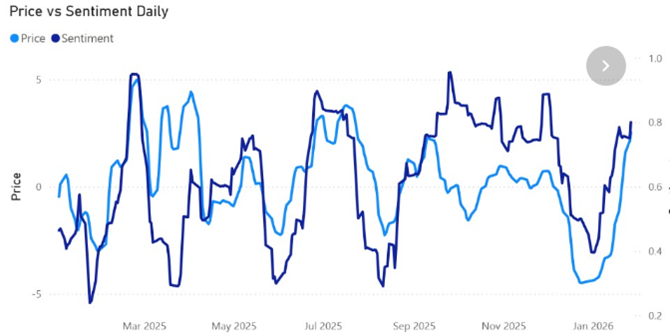
*Chart courtesy Arrow Shipbrokers and Research
A post–global financial crisis building frenzy left the sector perpetually stuck in a supply–demand imbalance, weighing on sentiment ever since.
However 2026 signals a meaningful shift in the demand outlook, with early foundations arguably laid in Q4 2025, coinciding with the US soybean trade delegation deployed in support of American farmers.
If only there were a Nobel Prize for Panamax patience.
Capesize Market Starts 2026 on a High Note
This feat makes it the second strongest start to a year on record. More incredible is that the forward curve shows that Capes could spend a large part of the year earning close to $30,000 per day.
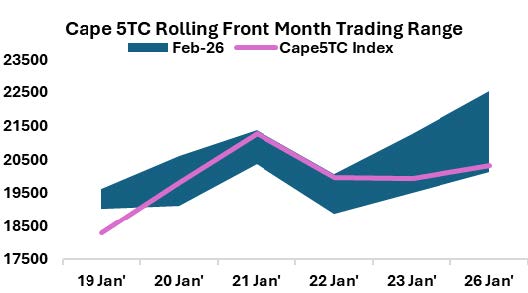
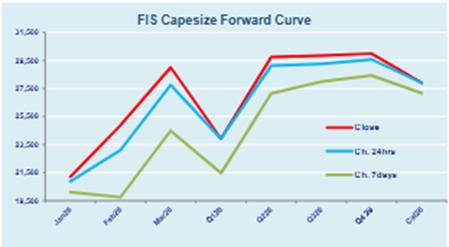
Charts courtesy Freight Investor Services Ltd (FIS)
This whilst being impressive outright is important to the rest of the dry bulk complex because the ratio of Cape versus Panamax on the forward crossing over 1.80 means that its almost certain the sub cape sector will be dragged up as cargo splitting occurs.
If the cure for high prices is high prices, it will be interesting to watch this ratio over the coming weeks.
Chinese Soybeans Import by Marketing Year
In a marketing year that runs September to August, this point of the year in early Quarter 1 and even Quarter 2 should be a benign time to see Beans volumes on dry bulk vessels.
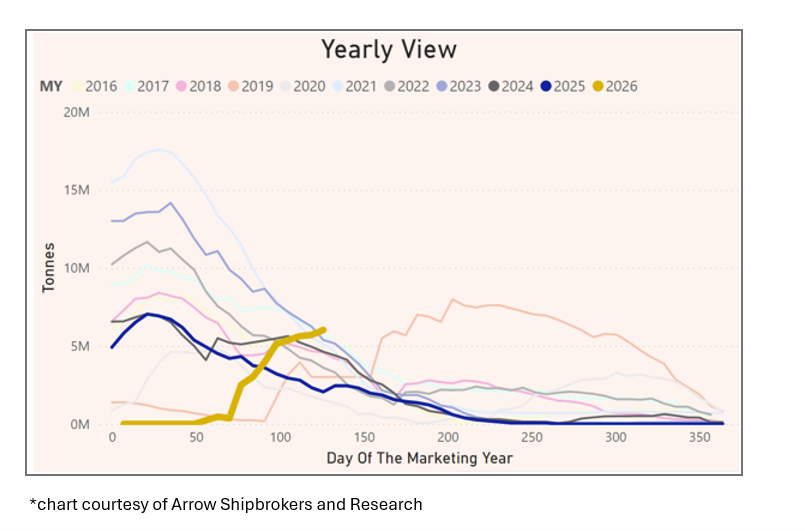
However in stark contrast to the normal cycle, China is busy fulfilling its commitment to buy US beans and this has delivered the Panamax dry bulk sector an explosive start to the year.
Once again politics Trumps the natural commodity flow cycles and we can probably expect that 2026 will continue to deliver many more volatile disruptions judging by the recent Davos assembly.
In the Year of the Horse – the Panamax Looks Set to be the Bolter
Whilst Supramax has been the stayer, having outperformed Panamax soundly since 2015, a hectic grains programme from the Atlantic to China has delivered Panamax earnings a fireworks start to the year.
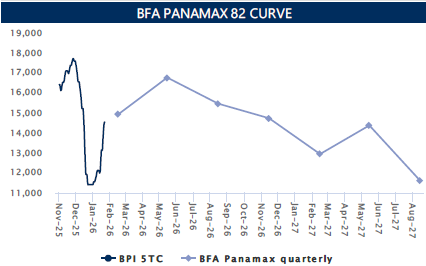
In less than three weeks of trading so far this year, Panamax has seen a 40% run-up in values, leaving Supramax lagging in its wake after dropping almost 20%.
The question is – Can Panamax finally beat Supramax earnings for the year?