
The festive season hopefully provided an opportunity to spend quality time with family and friends and, amid the celebrations, allowed for some quiet reflection time to look back at the rollercoaster year that was 2025, before gathering perspectives on the year ahead.
For those who reference numerology, 2025 represents an important inflection point as a Universal Year 9 (calculated as 2 + 0 + 2 + 5 = 9). As the final number in the single-digit sequence, it signifies the completion of a nine-year cycle that began in 2016.
From a market perspective, the numerological “transition” aligns with a period of market volatility and flux. As we close a challenging 2025 defined by geopolitical tensions, supply chain disruptions and economic volatility, 2026 emerges as a Universal Year 1 in numerology, symbolising new initiatives, leadership and the start of a fresh ideology cycle.
With a dry bulk shipping focus this could be translated into a signal for a pivotal shift toward stability, growth in emerging markets and strategic agility amid easing global pressures. The current global headlines don’t appear to support this reset quite yet, but there are some major thematics around the conflicts in Europe and the Middle East that could define 2026 and the start of the new cycle; which if it incorporates a rebuild programme across the different war zones, would provide a catalyst for all sectors of the dry bulk industry.
The only thing we know for certain is that we don’t know what will happen.
The past 12 months have shown that swans come in all colours and that even the founding principles of bulk shipping, specifically supply and demand and seasonality, can be influenced by external factors that are historically unrelated to global trade.
After the chaos and uncertainty of 2025, as we look for small wins, we can at least take some solace in the fact that 2026 will start on a Thursday.
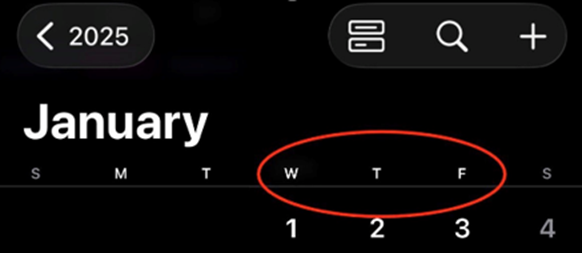
Although in the world of acronyms, we are just as likely to interpret TFS as “targeted financial sanctions” rather than the more familiar “thanks for sharing” used by my teenage children. Both may prove relevant in the coming months, as it subjectively feels that there is some progress towards greater certainty, or a strengthening of fundamentals, on the horizon.
This outlook may reflect a growing comfort with ambiguity, or it may be underpinned by a broader recognition of a clear disconnect between financial markets, which continue to trade at all-time highs and the real macroeconomic environment, where indicators such as higher unemployment and weaker oil demand are often seen as the canary in the coal mine.
These divergent conditions create different opportunities across the shipping sector. The derivatives, or FFA, market remains active, with traded ship days multiple times greater than global physical volumes, while changes in the global operating environment continue to challenge supply chains and sourcing strategies for bulk commodities.
In 2026, Legasea, specialising in the geared sector, will focus on its role as a reliable freight provider for our core customers, supporting them as their supply chain requirements become increasingly complex.
Tramp shipping requires a deep understanding of the nuances of bespoke trades and whilst there is a lot of white noise, from operational risks to new regulations, it does not change the fact many charterers are entirely dependent on dry bulk shipping solutions for their import and export requirements, which support their regional communities. This, in itself is a positive place to start as an operator looking towards 2026.